Our Most Popular Service is
TREE PRUNING & TRIMMING
Let Us Revitalize Your Trees & Reduce Risk of Damage & Injury
Tree Pruning, Tree Trimming, Tree Cutting
A well-maintained tree is a happy, thriving tree. Proper tree care is a long-term investment that can lead to substantial returns over a span of a lifetime. Well-pruned trees are attractive and can add considerable value to your property. Neglected trees, on the other hand, can be a safety hazard and financial liability.
Regular tree pruning is a preventative measure that will lead to less storm damage, an increase in the sale value and safety of your property, and zero sleepless nights (at least on account of your greenery.) Taking a proactive approach to tree trimming helps to reduce expensive and unexpected storm calls in the future. Staying proactive now means fewer unexpected problems later.
Tree pruning is a precise and delicate matter. It is a process best left to a professional arborist, as it demands an understanding of plant structure, biology, and aesthetics to ensure best results without harming your tree.

Knowing When to Prune
Each individual species of tree tolerates pruning at different frequencies and seasons. For example, never prune or remove Oak trees in the warmer months, as they can be susceptible to Oak Wilt, a vascular disease caused by a fungus whose spores are spread by beetles attracted to the sap secreted from a fresh wound. Once infected, the disease attacks the tree's water conducting system which can kill the tree. This fungus and beetles are dormant during the winter months, making it the ideal time to prune oaks.
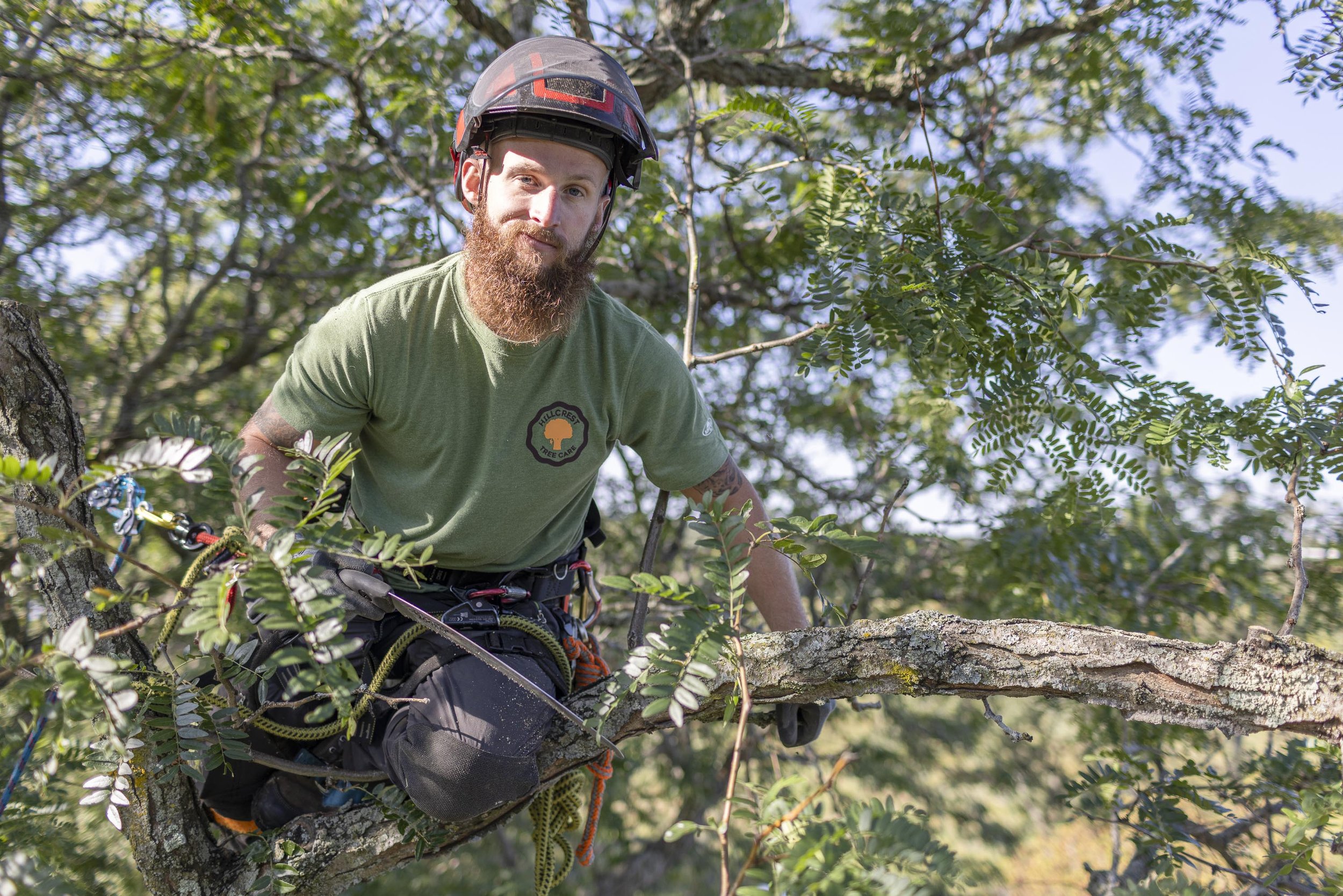
Hillcrest Tree Care is extremely knowledgeable in the finer points of tree pruning. Our professionals will take the time to discuss with you the best way to approach trimming your trees to ensure their beauty and safety for many years to come.
Tree Pruning May Consist of, but is Not Limited to:
Removal of limbs that may interfere with roofs, buildings, gutters, windows, and siding, driveway and sidewalk clearance
Removal of dead or weak limbs that pose a safety risk
Reduction in chance of catastrophic tree failure in old age
Eliminating branches that rub together
Removing diseased limbs that may cause greater issues for the entire tree
Improving the shape and outline of the tree to improve aesthetic value
Guiding young trees in the proper direction for each individual landscape
Thinning the tree to allow more sunlight to shine through
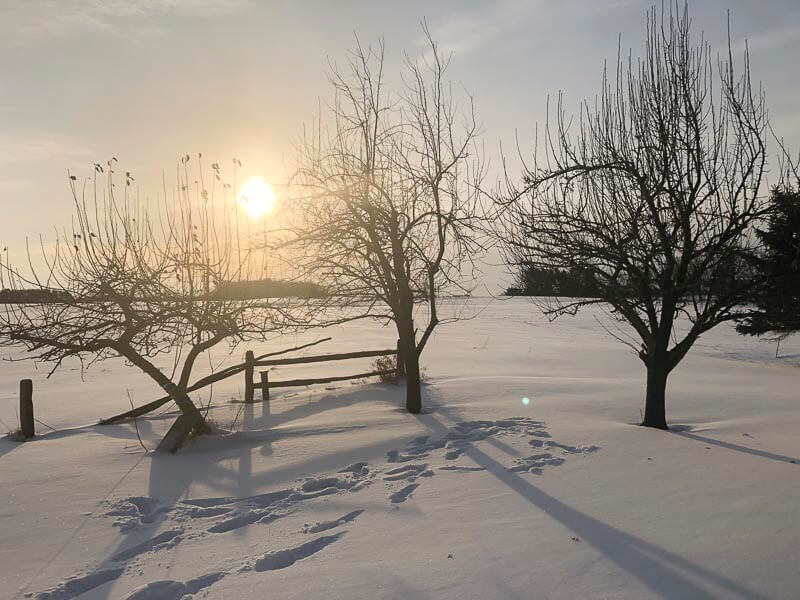
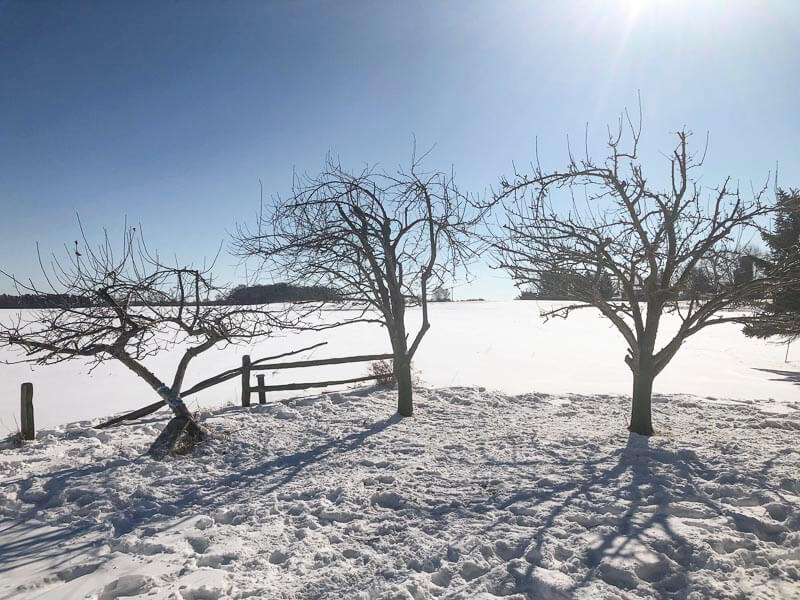
Before and After: We pruned these three fruit trees (two pear trees and an apple tree) in Stoughton, WI. Pruning makes a big difference to growth and fruit bearing! Learn more about winter tree pruning.
All pruning will be done in accordance with ISA best management practices and ANSI A300 standards, when possible, by trained and certified Arborists.
Tree Pruning FAQ
Straight answers from our certified arborists. Don't see your question? Call (608) 492-1124 and ask. Honest advice is always free.
Timing & Seasons
-
Trees can technically be pruned year-round, but some times of year are better than others from species to species. Ideal pruning period for any given tree variety depends on the species, health, and pruning objectives. For example:
Storm damaged or hazardous branches can and should be removed at any time of the year when safety is a concern.
-
It depends on the tree's age and situation. Young shade trees benefit from structural pruning every 2 to 3 years while their framework is forming. Mature trees typically need attention every 3 to 5 years. Fruit trees are usually pruned annually. Trees over roofs, driveways, or high-traffic areas should be inspected more often. During your free estimate we'll give you an honest recommendation, including "this tree doesn't need anything yet," which we say more often than you'd think.
-
Spring Season (April-May) is best for removing dead, hazardous, or damaged limbs. Spring is a great time of year to prune summer-blooming trees before the buds open, such as a Redbud or Serviceberry. Species to prune in spring include Maples, Ash, Birch, Elm, Catalpa, Kentucky Coffeetree, Hackberry, Mulberry, Fruit Trees (early spring), and Willow.
Summer Season(June-August) pruning includes light shaping or thinning trees to remove dead, damaged, or crossing branches. While it is important to avoid heavy cuts during this season, making minor cuts will help improve airflow and can remove diseased spots on a tree. Species to prune in the summer include Serviceberry (after blooming), Ash, Catalpa, Honeylocust (June), Kentucky Coffeetree, Hackberry, and Mulberry.
Fall Season(August-November) is not a great pruning season due to the risk of winter injury. However, there are situations in later autumn, after leaves drop, that allow a safe timeframe to prune. Species to prune in fall include Ginkgo, Hackberry, and Mulberry.
Dormant Season (December-March) is beneficial for structural pruning because the branch structure is easier to see, and the wounds created are less likely to attract insects and pathogens. Pruning wounds also heal quickly in this season. Species to prune in winter include Oak, Maple, Birch, Black Walnut, Honeylocust, Willow, Catalpa, Hackberry, Mulberry, Fruit Trees, and Kentucky Coffeetree
-
We prevent Oak Wilt by avoiding trimming oak trees between the months of April through November. All fresh-cut oak wood is susceptible to Oak Wilt, a fungal disease that spreads from diseased to healthy trees and can devastate a tree or group of trees in a single season. While we highly recommend waiting to prune oaks until dormant season, we encourage our clients to get on our winter pruning list to secure your place in line on our winter work list.
For Storm damaged Oaks trees, we recommend removing any broken limbs and painting the cuts with pruning seal before the tree naturally starts callusing and sealing the infection, which is about 72 hours.
-
Yes! Summer pruning is fine for most species and is actually useful for a few things: removing storm damage, slowing overly vigorous growth, clearing sightlines and structures, and thinning fruit trees. We just won't do routine work on oaks or elms until the risk window closes.
Tree Pruning & Trimming Nuts & Bolts
-
In everyday use, most people say "trimming" when they mean cutting back for clearance or appearance, and arborists say "pruning" to mean selective cuts made for the tree's health, structure, and safety. In practice we do both on the same visit: clearing limbs from your roof and gutters, and making the health and structure cuts a certified arborist knows to make. Whatever you call it, the work is done to the same professional standard.
-
Many people think trees need to be leafy and green to prune them well, but it’s actually easier to identify deadwood before a tree has leafed out.
It is important to choose a certified arborist when pruning your tree because they know exactly what to look for when pruning, even if your tree has not leafed out yet. Some things that our arborists look for before leaf out include:
Lack of buds often indicate dead branches on trees that normally have visible buds before spring growth. Dead branches often lack healthy buds and show no sign of recent growth.
Brittle twigs that snap clean and dry, compared to living twigs that have more of a bend.
Condition of bark can often indicate if a branch needs to be removed. Dead branches will often have missing, peeling, or discolored bark.
-
The value of hiring a skilled, certified arborist to prune your trees includes training, safety, tree health, and risk assessment, especially as tree size and complexity increase. The main points to consider hiring an arborist to prune your trees include:
Risk of injury comes with doing any type of tree work. Hillcrest Tree Care has the proper tools and equipment to safely reach the parts of your tree that need pruning.
Proper pruning techniques are crucial when pruning trees to prevent long-term problems including decay, weak branch attachments, and increased risk of storm damage. Certified arborists will look for the best place to make cuts, how much of the canopy to safely remove without causing stress, which branches should be retained for structural growth, and understanding how pruning affects future growth of the tree.
Hidden problems is something that our team automatically is looking for when pruning. Hillcrest Tree Care is trained to recognize disease, insect infestations, structural defects, root-related issues, and hazardous limbs that may not be identifiable to the untrained eye. There have been several situations where the team is performing a job and catches issues before becoming massive problems for homeowners.
Insurance and liability are guaranteed with Hillcrest Tree Care, as we are fully insured, whereas if there is damage to a roof, vehicle, or neighboring property during a DIY project, you could be responsible for the cost.
-
A good rule of thumb is no more than about 25 percent of the live canopy in a single season, and often much less for mature trees. Leaves are how a tree feeds itself; removing too many at once stresses the tree and can trigger weak, fast-growing shoots. If a tree needs major reduction, we'll usually recommend staging the work over more than one season. All of our pruning follows ISA best management practices and ANSI A300 standards.
-
Done correctly, no. Proper cuts are made just outside the branch collar, where the tree can naturally seal the wound, and every cut has a reason: removing dead or diseased wood, eliminating rubbing branches, improving structure, or providing clearance. Done incorrectly (flush cuts, stub cuts, over-thinning, topping), pruning absolutely can harm a tree, which is a big part of why credentials matter.
-
We won't top trees, and we'll talk you out of it if you ask. Topping (cutting main limbs back to stubs) is one of the most damaging things you can do to a tree. It creates large wounds that invite decay, and it triggers a flush of weakly attached shoots that grow back fast and break easily, leaving the tree taller-risk than before. If a tree is genuinely too big for its spot, the right options are proper crown reduction cuts made to lateral branches, or an honest conversation about removal and replanting the right species. We'll walk you through both options in a free, zero-obligation site visit.
-
Usually no, and that's on purpose. Research shows wound dressings tend to slow healing rather than help it, so modern standards recommend letting trees seal cuts naturally. The one important exception: Oaks wounded during the April-through-July oak wilt season get sealer immediately, because in that specific case the coating blocks the beetles that carry the disease.
-
Often, yes, with patience. Restoration pruning gradually selects the strongest of the regrowth shoots and removes the rest over several visits spread across a few years, slowly rebuilding a stable structure. We'll give you a realistic assessment of whether the tree is a good candidate.
-
Any limbs near the utility's high-voltage lines are the utility company's responsibility, and for safety reasons only their qualified line-clearance crews can work within a set distance of those wires. Contact your electric utility to report trees in the lines. We can handle everything outside that zone, and we're glad to coordinate so the whole tree gets addressed properly. Never attempt this yourself.
Pruning Cost, Scheduling & Logistics
-
It varies more than almost any home service, because every job is different: tree size, species, condition, how much work is needed, and how easy the tree is to access all affect the price. That's why we quote every job in person, for free, with no obligation. You'll have a clear written price before any work begins, and the price we quote is the price you pay. Make an Appointment
-
Typically no, as long as we've walked the job together beforehand (or during the estimate) and our crew has access to the trees. Many customers are at work while we complete the job. We'll confirm the details when we schedule.
-
Yes, always. Hauling brush and debris and leaving your property clean is part of every job, not an add-on. If you'd like to keep the wood for firewood or the chips for mulch, just tell us and we'll leave them stacked.
-
Fully, and we'll gladly provide our current certificate of insurance. Honestly, you should require proof of insurance from any tree company you let on your property. Tree work is dangerous, and if an uninsured crew has an accident at your home, the liability can land on you.
-
Yes. Our work is led by an ISA Certified Arborist (credential #WI-1297A) with Tree Risk Assessment Qualification (TRAQ), and we're members of the International Society of Arboriculture, the Wisconsin Arborist Association, and TCIA. "Certified Arborist" is a real credential with an exam and continuing education requirements, not a label anyone with a chainsaw can claim. Feel free to verify our certification through the ISA's online directory.
Other Tree Pruning Questions
-
Small ornamental trees and shrubs you can reach from the ground with hand tools? Go for it, and we're happy to point you to good resources. But anything requiring a ladder or a chainsaw overhead is genuinely dangerous work; tree care is consistently ranked among the most hazardous jobs in the country, and emergency rooms see thousands of homeowner ladder-and-chainsaw injuries every year. Beyond safety, bad cuts can permanently damage a tree that took decades to grow. Our rule of thumb: if your feet leave the ground, call us.
-
Common signs: dead or hanging branches, limbs touching your roof, siding, or gutters, branches rubbing against each other, cracked or split limbs after a storm, dense growth so thick that light can't get through the canopy, or a young tree developing multiple competing trunks. And sometimes the honest answer is that the tree is fine. If you're not sure, that's exactly what the free on-site estimate is for.
-
Sometimes. Removing diseased limbs early can stop some problems from spreading, and thinning can improve the airflow that keeps fungal issues down. But pruning isn't a cure-all, and wilting, early leaf drop, or dieback can signal issues (like oak wilt, root problems, or pests) that need diagnosis first. Cutting on the wrong tree at the wrong time can make things worse, so start with an assessment. Our arborists will tell you what's actually going on and whether pruning is the right tool.
-
Start with a conversation; most neighbors are reasonable, and the best outcome is usually agreeing to have the whole tree pruned properly rather than one side hacked back to a property line, which is bad for the tree and often looks worse.
Wisconsin generally allows property owners to trim branches that overhang their side, but there are limits, especially if cutting would seriously harm the tree, so for anything significant it's worth getting advice specific to your situation. We're arborists, not attorneys, but we can assess the tree, document its condition, and do the work correctly once everyone's on the same page.
Still Have Tree Pruning Questions?
Call (608) 492-1124 or request a free on-site estimate. We'll give you straight answers, even if the answer is "your trees are fine."